The German-France couple has reached a crossroads.
They are fighting over simmering issues, while having to present a united front to advance crucial EU energy initiatives.
This is the first article of a series that explores the complex network of differences, shared goals and opportunities to foster a pragmatic collaboration that can benefit the Franco-German – and ultimately the European – green energy sector.
Setting The Stage
These past 2 years, the Franco-German relationship in energy policy has plummeted to unknown depths.
Nuclear power has been an ongoing debate for the last 20+ years, with the administrative structure of the two countries fuelling the disagreement. France is a centralised State with large public companies that can easily organise country-wide power distribution, while Germany’s approach is more decentralised, based on the delegation of powers to lower levels of government.
Grid expansion is also a hot topic in France, because of the associated financial costs and opposition from citizens who object to the construction of energy grids in their areas. French policymakers are prioritising cross-border infrastructure, but voices are rising in Germany to prevent governments from using it as a bargaining tool.
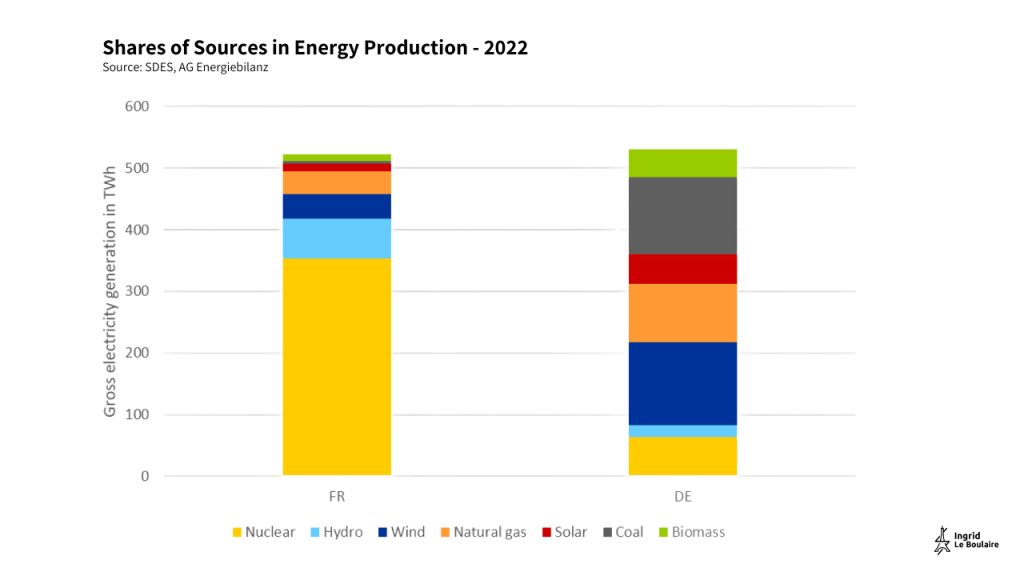
The industrial structure is also quite different, with non-replicable policies in both countries: Germany aims to protect and adapt its substantial industrial base, while France seeks to regain production capacity in line with decarbonization goals. The use of electricity, the available sources and prioritisation differ wildly within the border couple.
The power market reform is also a hot topic that was highlighted during the negotiations for EU energy emergency measures. Germany is in favour of preserving price signals to prevent energy shortages, while France advocated for stronger state intervention to lower prices. This divergence can be partly attributed to material interests, though fundamental disparities in their concepts of what the electricity market should achieve also contribute to the discord.
The State Aid for Power Plants issue revolves around France’s intentions to provide subsidies to its nuclear power plants, with support from central and eastern European countries. This has led to a deadlock between France and Germany, as these rules could potentially confer a competitive advantage to certain nations at the expense of others.
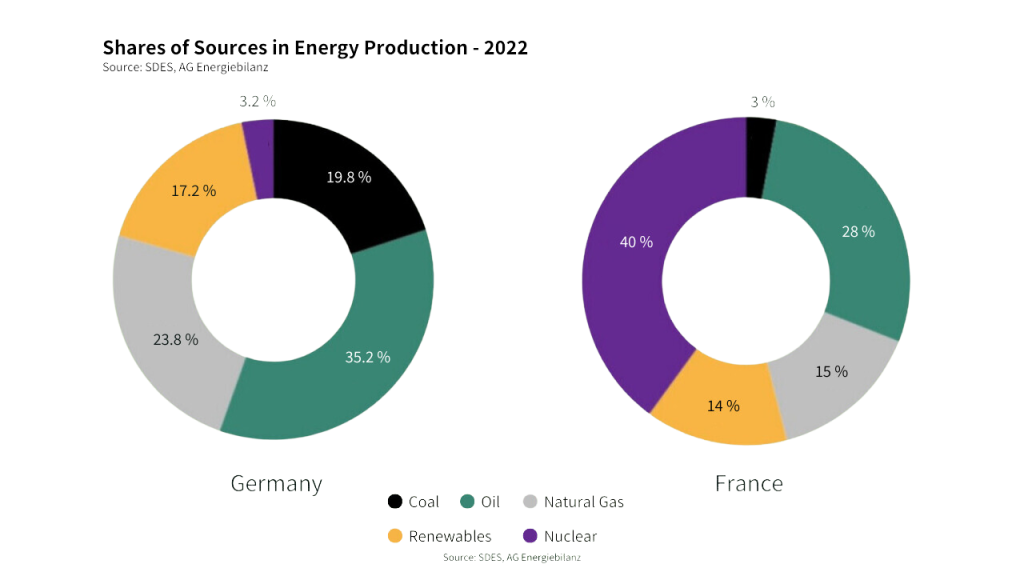
The support policies for energy-intensive industries in Germany aim at reducing energy costs for industries through subsidies if they do commit to decarbonising their operations. In contrast, France is more focused on robust re-industrialisation policies to safeguard its sovereignty in the green transformation. This dispute has risen during the 2022 energy crisis and has the potential to hinder progress on critical EU issues.
These ongoing disagreements highlight that the European Union doesn’t work along the same lines as the federal USA, with similar administrative systems able to integrate government laws. Our member states have very distinctive markets and administrations that need intensive debates to align, even with a shared strategic commitment.
In conclusion, the Franco-German partnership faces significant challenges regarding energy policy. However, these disagreements also bring opportunities for pragmatic collaboration that can ultimately benefit the green energy sector and, by extension, the entire European Union.
Stay tuned to read my next article; it explores the current energy landscape in Germany and France, offering a snapshot from which we will be able to derive important synergies.
We can help you manage your collaboration with German companies, taking into account not only language differences but also cultural and socio-political criteria. Check out our options here.
#ChooseFrance
#FrenchTouch
#greentech
#funding