The energy market in France and Germany has strong aces up their sleeves and significant challenges to face. Let’s get a look at the bigger picture to pinpoint common ground.
Germany
As a federal country with 16 Länder (administrative regions), Germany has split the structure of the energy market among centralised and regional responsibilities. Germany’s electricity generation market is also highly competitive, with more than one thousand market participants active in the fully liberalised market.
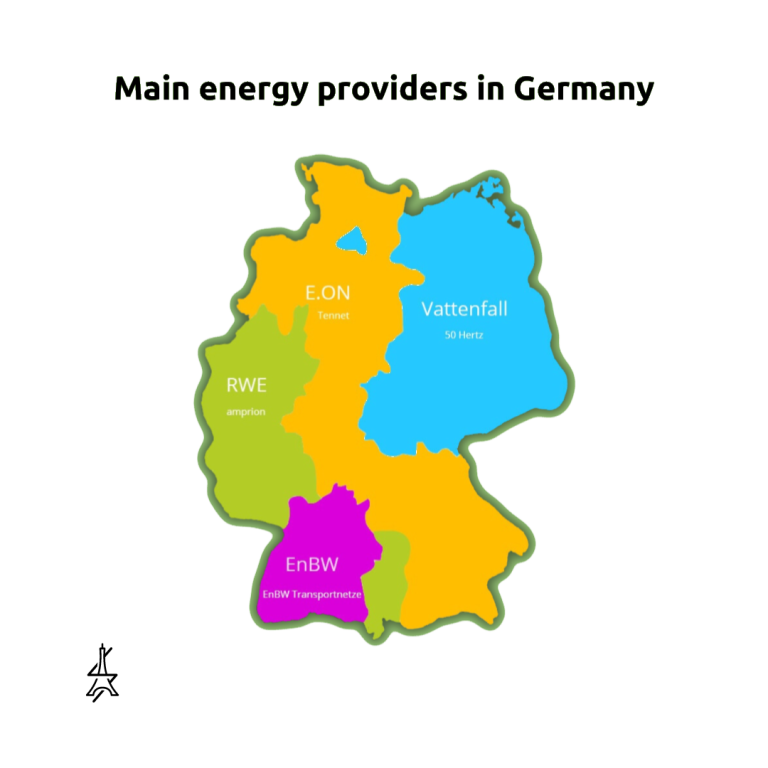
The federal government is responsible for setting the overall framework for energy policy and environmental protection, nature conservation, and consumer protection. However, as stated in the German Constitution: “the exercise of state powers and the administration of state affairs is a right and duty of the Länder”.
The administrative regions thus have a significant role in energy policies and their implementation. The Länder collect the vast majority of the taxes in Germany. The Federal Chancellor and the Minister Presidents of the Länder meet to discuss energy policy and other issues twice a year.
The Bundesnetzagentur is the regulatory office for electricity, gas, telecommunications, post, and railway markets, and ensures that the electricity market operates fairly and transparently.
Germany’s power market is highly competitive with decision power split among different levels.
France
As a centralised government over 13 regions, France has as highly centralised market structure.
It is also increasingly opening to competition, with more than 30 operating power suppliers.
France counts 3 major actors in the power space:
- EDF
- RTE
- ENEDIS
The historical energy giant still dominates the sector and delivers 91% of the total consumed power from nuclear plants. Its most important direct competitor is Engie, which buys power from EDF but also from smaller providers.
The transmission operator Réseau de Transport d’Électricité (RTE) is a subsidiary from EDF and also the only one responsible for transmitting high-voltage electricity throughout the country. The power distributor takes over power distribution at the local level along medium-voltage lines. ELD takes on this role in some specific areas.
The French electricity and gas markets are regulated by the French Energy Regulatory Commission (CRE), an independent public body. It guarantees non-discriminatory access to the grids for all market participants and ensures that the market operates in a fair and transparent manner.
However, the French energy transition has experienced significant delays because of issues with ageing nuclear plants, Covid pandemic and social disturbances, and implementation remains challenging despite the many reforms underway.
The French electricity market is still monopolistic but gradually opening to competition.
#ChooseFrance
#FrenchTouch
#greentech
#funding
We can help you manage your collaboration with German companies, taking into account not only language differences but also cultural and socio-political criteria.
Check out your options here.